

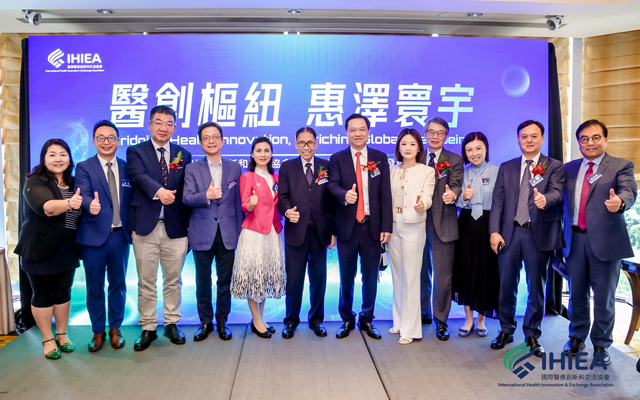
The International Health Innovation & Exchange Association (IHIEA) recently established its headquarters in Hong Kong with the aim of driving collaboration across the global healthcare, academic, and investment sectors.
Inaugurated in late June, the association serves as a strategic gateway connecting the Greater Bay Area and Asia with the global medical market.
Dennis Lu, co-founder and CEO of IHIEA, told TTGassociations: “What makes us unique is our neutral, non-profit platform – independent of government influence, free of political tasks, and positioned to bridge the gap between government and industry.
“We hope to tap into global life science unicorns and help them achieve a soft landing here before expanding into mainland China. Hong Kong’s value lies not just in connecting the world, but in adding value to innovation and validating global advancements.”
In terms of membership structure – which includes Member, Council Member, Executive Council, and Vice Chair Unit tiers – the association seeks to maximise its reach by courting medical-innovation venture capital firms, private equity groups, and major stakeholders in listed companies across Hong Kong and China.
“There are also many universities, hospitals, medical centers, and other professional organisations involved,” Lu added. “IHIEA aims to deliver greater value than the average non-profit by generating substantial returns for members – potentially 10, 20, or even 100 times the annual fee of HK$30,000 (US$3,827). It also strives to align the real interests of all participating members into a single strategic goal: advancing medical tourism in Hong Kong.”
According to Lu, private medical providers currently lack synergy and do not work together in a consolidated way. Moreover, the city’s medical tourism sector lags behind competitors like Shanghai and Singapore, making public-private partnership (PPP) models and incentive-driven government policies essential. A neutral third party like IHIEA can step in to align these disparate interests and drive progress.
“We also need to eliminate public misunderstandings regarding inbound medical tourism. This sector is a blessing rather than a detriment to the public interest. Hong Kong offers high-value medical tourism opportunities; we are not looking at a generic model that competes solely on cost.
“Our goal is to attract high-net-worth individuals from mainland China, South-east Asia, Europe, and the US, which will in turn fuel related industries such as hospitality, dining, investment, and entertainment,” stated Lu.
Looking ahead, the association plans to host an annual global health summit in Hong Kong, targeting 3,000 to 5,000 international healthcare providers, unicorn companies, and institutional investors.
IHIEA is also engaging with the Hong Kong Tourism Board to explore collaborative options, such as the Hong Kong Convention Ambassador programme. In 2H2026, the association will lead a delegation to South-east Asian countries to promote regional cooperation and exchange.


