

Geopolitical tensions, rising inflation, and evolving workforce values are prompting international associations to rethink how they run global events.
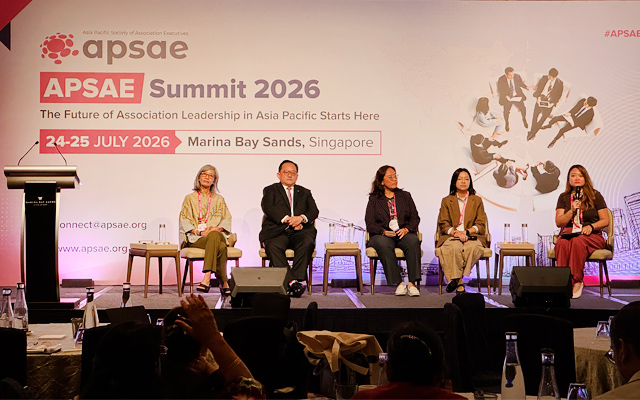
But as the Leveraging Ecosystem to Deliver Impact Amid Uncertainty panel during the inaugural APSAE Summit made clear, association executives are not navigating these operational challenges alone. An interconnected ecosystem – led by CVBs, venue operators, government agencies, and academia – is stepping up to help organisers materialise their objectives.
During the discussion, industry leaders highlighted how business events must transition from transactional venue rentals to platforms for knowledge exchange, community building, and measurable societal legacy.
According to Florence Chua, managing director for APAC at Professional Convention Management Association (PCMA), rising operational costs and changing travel patterns are reshaping event design and delivery across the Asia-Pacific region.
Chua indicated that while attendance numbers fluctuate based on regional dynamics and visa policies, successful organisations are adopting localised strategies to reach target audiences directly, rather than relying solely on global, centralised conventions.
This shift in association needs requires a parallel evolution among venue operators and CVBs. Wee Min Ong, vice president at Marina Bay Sands (MBS), opined that meeting facilities can no longer act merely as providers of square metres and F&B catering.
“After Covid, when face-to-face came to a halt, we realised that the real estate business is not the core business of convention centres. First and foremost, we are a platform where professional communities convene to interact, bridge connections, and elevate their professions,” Ong stated.
To facilitate this transition, MBS has accredited over 100 staff members in Event Design Collective (EDC) methodology. The framework works directly with organisers to reverse-engineer event formats around desired attendee behaviours and long-term engagement rather than traditional, static lecture formats.
CVBs are also revamping support models to look beyond traditional tourism metrics. Jaruwan Suwannasat, senior vice president of the Thailand Convention and Exhibition Bureau (TCEB), outlined Thailand’s triple-pillar approach – Win, Promote, and Develop – which integrates up to 12 national priority industries with academic nodes, local municipalities, and airline partners to support event bottom lines, and drive regional distribution.
TCEB’s initiatives, such as the First Time Ever campaign – encouraging events to expand beyond Bangkok to secondary cities like Chiang Mai and Phuket – and the Road to Net Zero sustainability guidelines, demonstrate how government agencies can align event delivery with broader national economic and environmental goals.
However, experts caution that associations often underutilise the full scope of available public resources. Jane Vong Holmes, senior manager for Asia at GainingEdge, urged meeting planners to look outside traditional tourism channels.
“Because the measurement for conventions has historically been tourism value, most organisers only approach the Ministry of Tourism. In reality, the Ministries of Health, Innovation, or Science and Technology, along with mainstream media and local universities, are vital components of the ecosystem that can expand an event’s reach and secure public policy support,” Vong Holmes explained.
Vong Holmes cited an international medical convention in Ireland that worked with local universities and regional bureaus to craft a strategic declaration, ultimately driving a policy shift that increased rural general practitioner rates in the country from 1.9 to 3.1 per cent.
The panel concluded with a shared call to action: association leadership must move past the traditional model of merely “serving” members toward actively enabling them – particularly small and medium enterprises (SMEs) that rely on industry conventions for access, network equity, and business development.


