

Associations across the Asia-Pacific region are facing rising inflation, shifting regulations, and evolving member expectations, which expose the limits of traditional membership dues, forcing leaders to completely rethink their operating models.
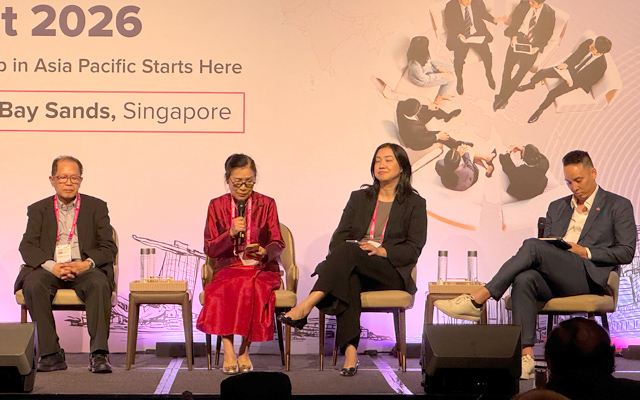
At a panel discussion titled Beyond Dues – Monetising Data, Partnerships & Non-Due Revenues during the inaugural APSAE Summit last week in Singapore, four association speakers outlined how associations can move away from transactional memberships toward collaborative ecosystems driven by cross-pollination, commercial discipline, and multi-sector partnerships.
A common friction point for international associations is the perceived competition with regional bodies over the same member base. However, leaders at the panel argued that true scale is achieved by strengthening local partners rather than replacing them.
Jessie Li, regional director for East & South-east Asia at Society of Actuaries (SOA), opined that regional and global entities fulfil distinct yet complementary roles within the ecosystem.
“It’s not a question for us whether or not we work with our local partners. It’s the question more like how we better collaborate with our local partners so that we can together grow our profession,” Li explained.
Highlighting their recent flagship symposium in Taipei – co-hosted with the Actuarial Institute of Chinese Taipei – Li noted that success relies on leveraging complementary strengths.
“We bring international experience, speakers, and global engagement, while our local association brings stronger on-the-ground experience, regulatory connections, and local knowledge. Both organisations became stronger as a result,” Li added.
For trade groups facing constrained budgets, generating non-dues revenue is essential for long-term viability. Rather than developing costly products in-house, organisations are finding success by co-creating value with knowledge partners and member institutions.
Amador Honrado Dy, secretary of the Asian Bankers Association (ABA), shared how his association works with knowledge partners to deliver technical content to members without driving up internal overheads.
“Most of these knowledge partners are organisations that provide services or products useful to banks… They offer to conduct webinars on topics of interest, and we look at ways to collaborate that bring value to our members,” shared Dy.
To maximise the impact of corporate sponsorships while maintaining trust, ABA structures partnerships to enhance attendee experience and institutional visibility.
He added: “We identify sponsor organisations willing to cover the costs of inviting renowned speakers. Sponsors get high-level visibility, which boosts attendance and elevates the profile of every partner involved.”
While mission drives non-profit organisations, sustaining it requires an agile, commercially-minded approach to operations.
Bryan Tay, general manager of the Singapore FinTech Association (SFA), explained how running an association with startup-like discipline enables small teams to punch above their weight.
“We function like a startup… Membership dues are only going to account for between 30 to 40 per cent of your total revenue. The rest has to come from partnership streams, sponsorship streams, and other models,” said Tay.
Tay highlighted SFA’s talent initiative – an internship platform launched in tandem with government agencies to bridge the fintech skill gap – as an example of co-creating ecosystem value while embedding smart monetisation.
“If you do something good for the general ecosystem, you do something good for your members as well. (For example,) we create a free portal for the community, but if you are a member, you can boost your posts or access our management portal. You add commercial models on top of that ecosystem value,” said Tay.
When asked what advice he would give smaller associations looking to build financial resilience, Tay pointed to operational accountability.
“Every spend has to have an ROI for it. It doesn’t have to be a commercial value all the time, but you need to have a clear thought process of how it drives your mission and leads to a sustainable place,” he said.
Panelists also agreed that cross-sector alignment fails without strong governance and clear shared goals.
Supaporn Chuangchid, executive secretary of the Association of Universities of Asia and the Pacific, reinforced that cross-pollination across academia, government, and the private sector requires long-term trust to yield meaningful impact.
“The future of associations lies not simply in generating more revenue, but in continuously creating greater value – furthering meaningful partnerships and remaining relevant to the needs of our members and society,” she concluded.


